
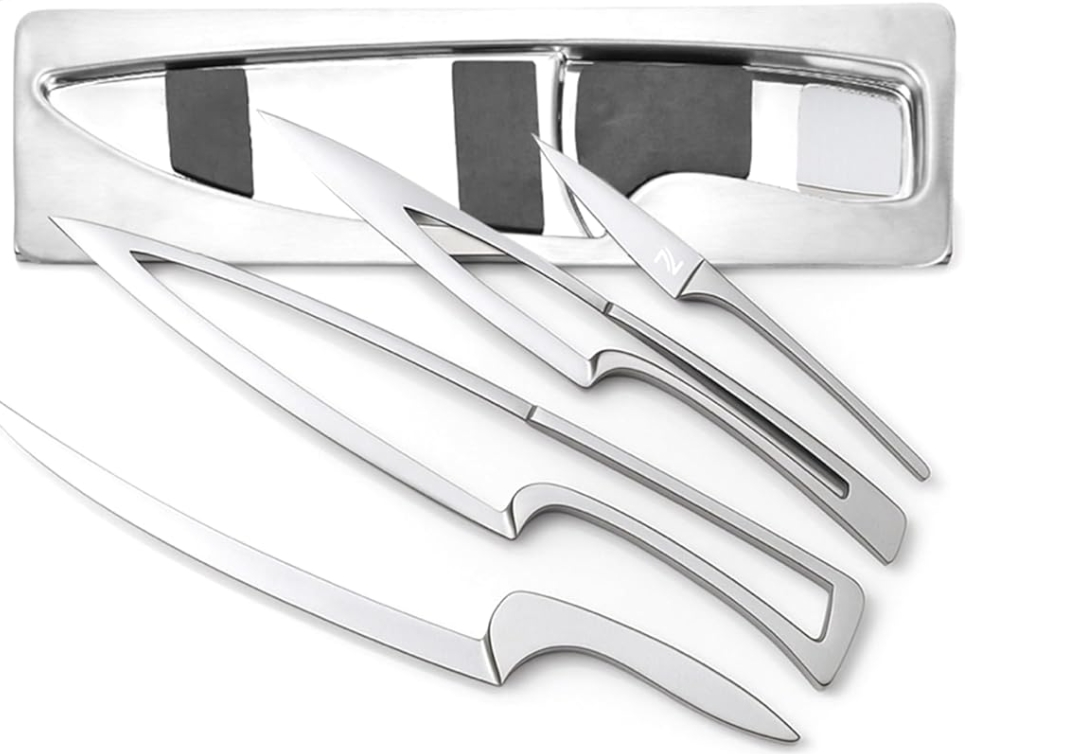
Traditional knife storage requires drawer space, magnetic wall strips, or countertop blocks that consume valuable kitchen real estate. Nesting knife sets solve this problem through clever engineering that allows multiple blades to fit inside one another like Russian dolls.
This stackable knife design caught attention when Mia Schmallenbach created the Deglon Meeting Knife Set years ago. That original stainless steel collection demonstrated how a complete knife set could occupy the footprint of a single blade. The concept inspired multiple manufacturers to develop their own versions at various price points.

Nesting knives, Knife in Knife
How nesting kitchen knives work
Each knife in a nesting set features a blade profile slightly smaller than the next size up. The paring knife fits inside the utility knife. The utility knife slides into the chef knife. The chef knife nestles within the slicer. A matching container or holder keeps the assembled set together.
This telescoping design means pulling one knife automatically reveals the next blade underneath. Kitchen onlookers often react with surprise watching someone extract knife after knife from what appeared to be a single utensil.
The engineering requires precise manufacturing tolerances. Each blade must fit snugly enough to stay secure during storage yet release smoothly when needed. Handle proportions follow similar nesting geometry to maintain the compact stacked profile.

Knife types included in nesting sets
Most nesting knife collections include four to five essential blades that cover standard kitchen cutting tasks.
| Knife type | Typical blade length | Common uses |
|---|---|---|
| Paring knife | 3 to 4 inches | Peeling, trimming, detailed cuts |
| Utility knife | 5 to 6 inches | Slicing sandwiches, cutting vegetables |
| Chef knife | 7 to 8 inches | Chopping, dicing, mincing |
| Fillet knife | 6 to 7 inches | Fish preparation, delicate slicing |
| Slicer | 8 to 10 inches | Carving meats, cutting large items |
This blade selection handles daily meal preparation without requiring additional knives for most home cooks.
NestKnife: modern take on the nesting concept

NestKnife developed a stainless steel knife set that updates the nesting knife concept with contemporary features. Their collection includes four blades: chef knife, utility knife, paring knife, and fillet knife. Each blade uses brushed stainless steel construction for durability and edge retention.
The brand incorporated a patented push-down mechanism for knife access. Pressing gently on the handle causes each blade to pop up from the storage position. This system eliminates tugging or awkward grip angles when retrieving knives.
Magnetic components built into the holder keep blades secure during storage. The magnets prevent accidental sliding or shifting that could dull cutting edges or create safety hazards.
Handle design on NestKnife products emphasizes ergonomic grip and balanced weight distribution. Extended cutting sessions require comfortable handles that reduce hand fatigue. The balanced construction helps maintain control during precise cutting motions.
Storage advantages for small kitchens

Apartments, condos, tiny homes, and RV kitchens benefit most from nesting knife storage. A complete four-knife set occupies roughly the same counter space as a coffee mug. Drawer storage requires only the footprint of the largest blade rather than space for four separate knives.
Traditional knife blocks measure 6 to 8 inches wide and 12 to 14 inches tall. Magnetic strips need 12 to 18 inches of wall space. Nesting sets eliminate these space requirements entirely.
The compact profile also suits travelers who cook at rental properties or vacation homes. Packing a complete knife set becomes practical when the entire collection fits inside a single protective case matching the dimensions of one knife.
Material and construction considerations
Stainless steel remains the standard material for nesting knife sets. The alloy resists corrosion, maintains sharpness through regular use, and cleans easily after food preparation.
Higher quality nesting sets use steel grades with elevated carbon content for improved edge retention. Budget options may use softer steel that requires more frequent sharpening.
Handle materials vary between manufacturers. Some nesting designs integrate handles into the blade steel for seamless one-piece construction. Others attach separate handle materials that affect grip texture and visual appearance.
Brushed steel finishes hide fingerprints and minor scratches better than polished mirror finishes. This practical consideration matters for kitchen tools that receive daily handling.
Comparing nesting sets to traditional knife storage
| Feature | Nesting knife set | Traditional knife block | Magnetic wall strip |
|---|---|---|---|
| Counter space needed | Minimal | 6 to 8 inches | None |
| Wall space needed | None | None | 12 to 18 inches |
| Drawer storage | Single knife footprint | Multiple slots required | Not applicable |
| Blade protection | Enclosed design | Slot insertion | Exposed blades |
| Portability | Excellent | Poor | Not portable |
| Knife capacity | 4 to 5 blades | 6 to 12 blades | 4 to 8 blades |
| Visual impact | Modern sculptural | Traditional wooden | Industrial modern |
Practical limitations of nesting knife designs
The space efficiency comes with tradeoffs that buyers should understand before purchasing.
Blade selection remains fixed. Traditional storage allows adding or replacing individual knives. Nesting sets function as complete systems where individual blade replacement proves difficult or impossible.
Maximum knife capacity stays lower than large knife blocks. Serious home cooks or professionals who use eight or more specialty blades may find nesting sets insufficient for their needs.
Sharpening requires extra care. The nested geometry means blade edges sit close together during storage. Improper reassembly after sharpening could cause edge contact that dulls blades prematurely.
Cleaning the entire set takes more time than washing a single knife. Each blade requires individual attention before reassembly into the nested configuration.
Selecting a nesting knife set
Match your purchase to your actual cooking habits and kitchen constraints.
Small kitchen spaces benefit most from the compact storage design. Cooks with ample counter and drawer space may prefer traditional storage that allows easier individual knife access.
Blade quality matters more than the nesting mechanism. Examine steel grade, edge geometry, and handle construction the same way you would evaluate any knife purchase. Clever storage means little if the blades perform poorly.
Budget options exist at much lower prices than the original Deglon design. Amazon and kitchen specialty retailers stock multiple nesting knife brands across various price tiers. Quality varies considerably between manufacturers.
Consider how frequently you use multiple knives during single cooking sessions. If you regularly switch between three or four blades while preparing meals, the sequential access pattern of nesting sets adds minor inconvenience compared to having all knives visible and immediately accessible.
Care and maintenance for nested kitchen knives
Hand washing protects both blade edges and the nesting mechanism. Dishwasher cycles can shift blade positions during water jet spray, potentially causing edge damage.
Dry each blade completely before reassembly. Moisture trapped between nested knives promotes corrosion even on stainless steel.
Store the assembled set in a dry location away from sink splash zones. The enclosed design can trap humidity if positioned near frequent water exposure.
Sharpen blades individually using standard knife sharpening techniques. Reassemble carefully to ensure proper blade alignment within the nested stack.
Periodic inspection of the nesting mechanism prevents problems. Check that release systems function smoothly and magnetic components maintain adequate holding strength.
Kitchen aesthetics and modern design
Nesting knife sets appeal to cooks who appreciate minimalist kitchen design. The sculptural appearance of a complete knife set compressed into a single geometric form creates visual interest beyond practical function.
Brushed stainless steel finishes complement contemporary kitchen appliances and fixtures. The metallic appearance coordinates with stainless refrigerators, ranges, and hardware.
The space saving profile allows countertop display without cluttering work surfaces. A nesting set can serve as a functional kitchen accessory that contributes to room aesthetics rather than detracting from visual cleanliness.
Modern knife block designs including nesting sets reflect broader trends toward compact multifunctional kitchen tools. Urban living spaces demand products that maximize utility while minimizing physical footprint. Nesting knives deliver this efficiency in a category traditionally resistant to space optimization.
You may also like https://rococo-knives.com